
Being an Archaeologist
Mythbuster:
Archaeologists study ancient human and dinosaur bones.
Archaeologists do study ancient human bones, but not dinosaur bones – the specialists who study dinosaur bones and fossils are called palaeontologists.
Dr Diane explaining why she wanted to be an archaeologist.
Page Content
What is Archaeology?

Being an archaeologist, I try to understand how people lived in the past by looking at the things they left behind.
How to pronounce the word archaeology:
Archaeologists are sort of like detectives, in that we find clues about the past through digging (excavation) then piece these clues together to create a picture of what life might have been like in the ancient world. From this we also try to make a chronology, that is a sequence of events and dates through time.
We do need to be careful though when making interpretations about the past, as of course we can’t ask the ancient people themselves and so we speak for them.
There can be many different scenarios for how an artefact was used, so archaeologists need to look at all the different scenarios and then choose the one that has the best evidence to support it.
How to pronounce the word artefact:
Dr Diane explaining the tips for being an archaeologist.
While it is wonderful to find objects of beauty, the past is about people, not objects and what is more important is the story behind the objects. We can only tell this story if the artefact is in its original resting place and has not been moved.
It is for this reason that objects found through excavation are especially important because being underground they are often protected from nature and humans.

Archaeologists work all over the world from fields in England to the deserts in Peru, to the rainforest, which is where I work.
Sometimes we are known for our spectacular discoveries such as Howard Carter’s find of the tomb of Tutankhamun, one of the rulers (pharaohs) of Egypt as well as proposing new archaeological techniques such as Sir Williams Flinders Petrie or Sir Mortimer Wheeler.

One of the reasons why I enjoy doing archaeology so much is that it is made up of many different subjects.
We use maths in measuring out our square test pits as well as in finding patterning in different pottery or tool types. We use geography when we look at maps and aerial photos. We use science in many ways, from following the scientific method in collecting data and conducting experiments, the dating methods we use and working with the environment in plants and bones we find.
Dr Diane explaining her typical day.
Of course, we use history too for chronologies, but archaeology goes one step further than history in looking at societies without writing.
History is restricted to the past 5000 years when writing has been in existence, whereas archaeology has no time limit and can go back to around 2.5 million years, when our ancestors lived.
Also, history focuses on societies with writing and those who knew how to write were usually the richest and most powerful people in these societies (the elite or nobles). In archaeology we can gain information about all society including rich and poor, men and women and even children.
What remains do you think a child would leave behind?

Children’s Activities
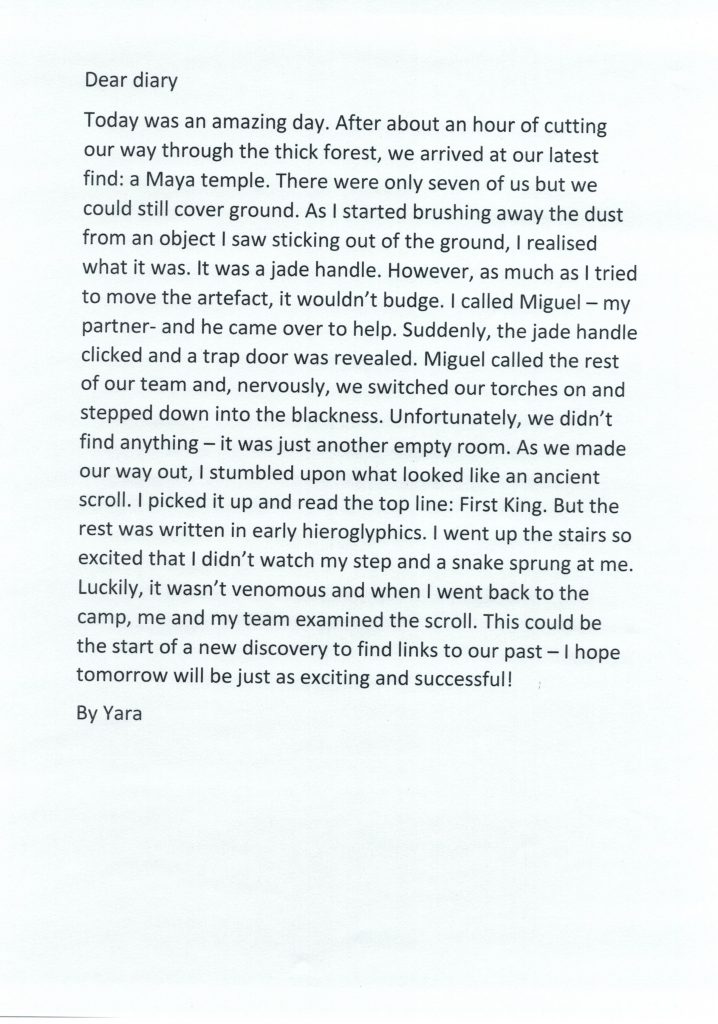


How about writing a diary of a day in the life of an archaeologist, or a biography on Dr Diane like the ones above?

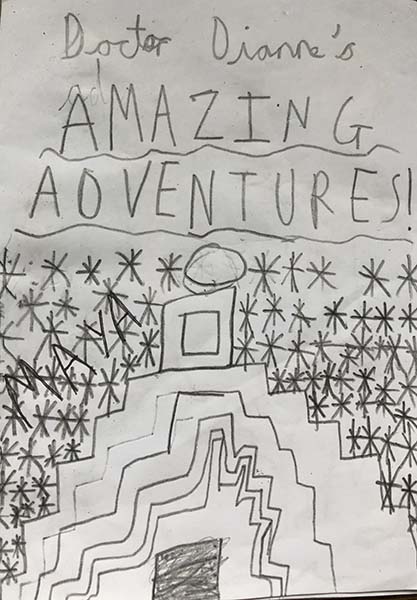
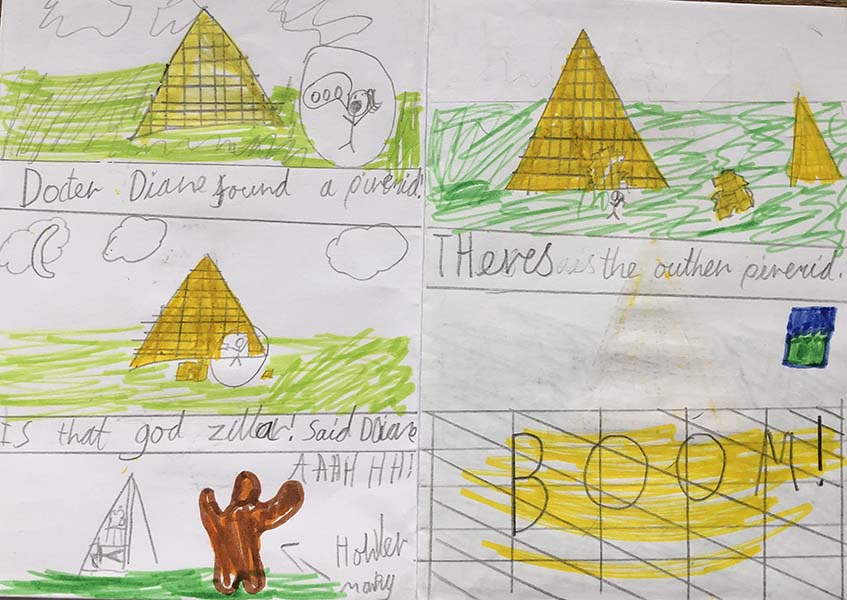
Or create cartoons about being an archaeologist, like these from Snape Primary school, Suffolk
Resources to Download
These resources were written by teachers on a CPD trip with Dr Diane to the Maya area. You can download these below.
Please note – you will need to use your personal, rather than your school’s email address to download these files, as most schools disable the ability to receive files from outside their domain.
You can access the complete scheme of work for a small fee, in the form of a donation to the charity Chok Education, which supports the education of Maya children.
Dr Diane’s Archaeology Wordsearch

Live Q&A with Dr Diane
Dr Diane will be available in real-time using the platform of your choice to answer any questions children and teachers may have about her life as an archaeologist and her extraordinary finds in the Maya rainforest.

Virtual Visit by Dr Diane
A virtual visit by Dr Diane to your school! The first part of this interactive video is Dr Diane discussing her job as an archaeologist and what it is like to work and live in a rainforest. The second part details the magnificent achievements of the Maya along with Dr Diane’s discoveries.
A virtual visit from Dr Diane to your school! Look at the wonders of Maya art and try your hand at being an archaeologist in working out what the objects displayed are used for.
Alternatively…
You can carry out a history detective challenge with your class using images of Maya artefacts with questions and answers.


Other Resources
Lamanai Archaeology Project
Website of the Lamanai Archaeology Project with many pictures, articles and information about this site located in Belize.
Access the Lamanai Archaeology Project website
A Puzzle in the Peten
Excavating at Waka, an archaeological dig in the Peten. The website details the practicalities of excavating such as setting up camp and includes a field diary:
Access the Waka Project website
Caracol
A major archaeological site in Belize, includes resources for children, including a story describing the life of 10 year-old Elyse, the daughter of archaeologists at the University of Central Florida, who helps out at the site:
Access the Caracol Project website