
History and Archaeology: Dating
Can you imagine trying to understand the past without any writing at all? No books, no letters, no calendars, and no internet. It sounds almost impossible. Yet for most of human history, writing did not exist.
Because of this, archaeologists often cannot rely on written records in the way historians do. Instead, they must take their investigations a step further, using objects, buildings and layers of soil to work out how people lived and when events happened.


Page Content
Relative Dating
There are two sorts of dating in archaeology – Relative Dating and Absolute Dating
Sometimes, archaeologists can’t tell the exact age of an artefact—but they can say if it’s older or younger than something else. This is called relative dating.
We also use stratification and superposition to help. Stratification is when layers of earth and objects are stacked one on top of the other as we dig down. You can often spot these layers by changes in colour, texture or the types of artefacts found in them.

A test pit that Dr Diane dug showing the layers and changes in colour.
The law of superposition is simple: the bottom layer was laid down first, so it’s the oldest, and the top layer was laid down last, so it’s the youngest. For example, if a pot is buried in the bottom layer and a tool is in the top layer, which one do you think is older?
But we have to be careful! Sometimes tree roots, water, worms, or other animals can mix the layers, moving objects from one layer to another, which can make them seem older or younger than they really are.

In this profile artefacts found in the midden will be later in date than the burial and luckily as the floors are intact we know that the layers aren’t mixed.
When pottery is found, archaeologists can often tell how old it is using a method called seriation. That’s when we line up pots by their shape, style, and decoration — from oldest to newest.
It’s a bit like films: first came black and white movies, then colour ones, and now films with computer graphics. Pottery styles changed just like that, and by studying them, we can work out which time period they belong to.
Why don’t you have a guess at the sherds (pottery pieces) below?
Questions: Which is the earliest and which is the latest?

Answer

Absolute Dating
Absolute dating is when you can give the actual age of the artefact, for example this pot was made in 200 BC.
Examples are:
1 – Dendrochronology
Many trees produce a ring of new wood each year and these circles of growth can be easily seen in a cross section of a tree. These rings are not uniform in thickness, they can be affected by changes in the weather – more rainfall will produce a large growth ring.
The method is based on counting the annual growth rings you can see in the cross section of cut trees.

By counting back from a known starting point and matching patterns of rings from trees with overlapping lifetimes, the tree-ring sequence can be projected back for thousands of years, such as oak trees in Germany going back 9500 years!
Radiocarbon 14C is produced in the atmosphere and absorbed as carbon dioxide by plants through photosynthesis and animals when they eat plants. When the plant or animal dies no further 14C is taken in. Actually, the amount present at this time begins to decrease.
The rate of this decay is measured and so dating can be carried out by calculating the length of time elapsed since the death of the plant or animal you are investigating.
Charcoal from burned materials such as fire pits (hearths) is most commonly used, but you can also date other organic materials such as wood, seed or bone. Radiocarbon dating goes back to 50,000 years ago!

Ancient Writing
Writing was invented independently around the world on at least 5 different occasions – in Mesopotamia, Egypt, China, the Indus Valley and the Maya area. It was also used in different ways, from accounting and administration, recounting history, to religion and the calendar.
People who study ancient writings are called epigraphers and they have a hard time trying to decipher, that is translate, ancient writings that were once known and now lost.
To decipher an ancient writing there are several important things we need to know such as the language and the culture it refers to, what type of type of writing system we are dealing with, that is whether is an alphabet like ours, or something different.
We need to have lots of examples of the writing available for study and preferably, an inscription that has a statement written in the unknown language with the same thing written in a language we do know, like the Rosetta Stone.
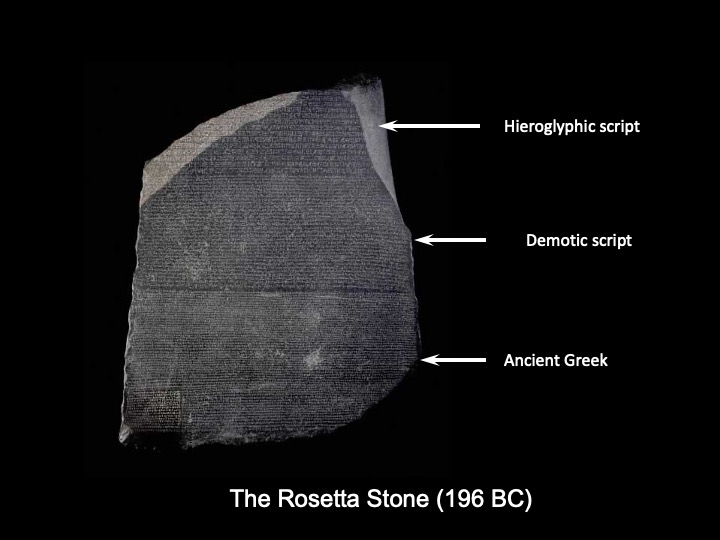
The Rosetta Stone was an amazing find for epigraphers as it has a statement written in ancient Egyptian hieroglyphs, this statement is then repeated in the Demotic script (everyday Egyptian) and then repeated again in the well-known Greek alphabet.
Amazing Fact: The Inca had a great civilisation spanning thousands of miles, but they didn’t have writing. Instead they had knotted cords made of string called quipu!
Children’s Activities
Classroom Excavation
Children can carry out a small-scale excavation using large cardboard boxes to uncover layers, record their findings and have a go at dating. This activity is archaeology in practice and clearly shows the importance of recording and context. You can use this activity for any subject that the class is learning in history.
Materials
- Strong cardboard boxes and pieces of cardboard
- Bubble wrap (optional)
- Soil
- Items such as seeds, stones, broken pieces of pottery, dried food etc., or laminated photos of artefacts from the period of history you are teaching
- Plastic cover for the table
- Tablespoons
- Bucket to put the excavated soil in
- Small plastic bags to hold the artefacts
- Pens and Pencils
- Brushes
Instructions
- Make a story for each layer about what the people were doing, that is food they were eating, things they were making and so on. Think about what you want the children to learn, so when packing the box you can add items that help them answer your questions.
- Fill each box with a layer of dirt about 10 cm thick adding the items that together would tell a story, such as broken pieces of a bowl together with some food, or charcoal showing the remains of a fire. Pack the earth in tightly.
- Place either a piece of cardboard or bubble wrap on top to divide the levels, this can act as a ‘floor’.
- Add another layer of dirt with items and then add another floor. Then add a final layer of dirt on top with items, so you have 3 layers.
- Explain to the children that they will be excavating a test pit to not just find things, but to understand the ways of life from the finds. Let them know how many levels there are and ask them to dig carefully, that is try not to dig holes with the spoons, they need to scrape the spoons over the earth as they always need to be level when they dig down.
- Have one person be the excavator, one be the recorder, another be the bagger of materials and so on.
- Ask them questions such as which objects are the earliest and which are the latest? What did the people eat? What were the artefacts used for? What can the finds tell us about their life?
- Each group can present their finds and conclusions to the class.
Resources by Dr Diane
Archaeology Wordsearch

Live Q&A with Dr Diane
Meet Dr Diane live! Children and teachers can chat with her in real time and ask questions about her exciting life as an archaeologist and her amazing discoveries in the Maya rainforest.
