How do we know about the Maya?

Below is an excerpt from Dr Diane’s book “Teaching the Maya as part of the National Curriculum“, which will be available in the Maya shop shortly.
Sources on the Maya
We know about the Maya from a variety of sources; archaeology, ethnohistory and ethnography. The earliest known recordings of the ancient Maya were written by the European missionaries and native Maya during and after the Spanish conquest. Information concerning everyday life, religious beliefs and historical information are all found in these. Although the Maya had paper books and thousands of them, they either perished in the humidity of the rainforest or were burned by the conquistadors and missionaries.
The archaeological record can only reveal so much and so we do have ‘black holes’ for particular areas of Maya life such as medicine, law, or education. In addition, the archaeological record is skewed in giving information primarily about elite life, all art was commissioned by the rulers and reflected their values and elite structures were made of permanent material (limestone), which preserved through time unlike the average home built of perishable materials.
Ethnohistorical Sources
Ethnohistory is the study of cultures and indigenous peoples’ customs by examining historical records, in this instance colonial documents written by the Spanish missionaries and native people themselves. For the Maya, the main historical record is Diego de Landa’s Yucatan before and After the Conquest (Tozzer 1941) written in 1566. The book includes information concerning the Mayan language, hieroglyphs, religious beliefs, rituals and culture in general and was written with the help of Maya nobles such as Don Juan Nacho Cocom and Gaspar Antonio Chi.
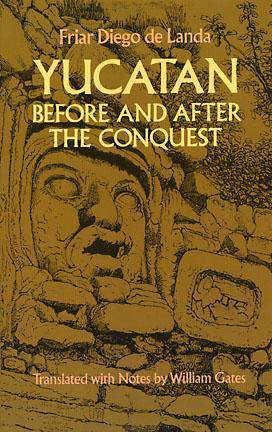
Diego de Landa was notorious for his cruelty against the Maya and his involvement in the burning of many of the Maya codices. He was sent to the Maya area to help in their conversion to Roman Catholicism and many Maya who did not convert or were found to practice their religion were tortured in order to “save them from hell’. De Landa is known for burning at least 27 ancient codices and in his words:
“we found a large number of these characters and, as they contained nothing in which there were not to be seen superstition and lies of the devil, we burned them all, which they (the Maya) regretted to an amazing degree and which caused them much affliction (Landa 1941: 78)”
He was later arrested and sent to jail and wrote his book whilst on trial. Ironically, it is his book (rather than the original codices which would have been invaluable) that archaeologists and historians look to for information about Maya culture and it was one of the few sources used in the decipherment of Maya writing.
Fray Bartolomé de las Casas, a Dominican priest whose book Apologetica (e accent) historia sumaria (1967) included 13 chapters concerning the Maya, including references to New Year ceremonies in the Guatemalan highlands. The missionary wanted to convince Spain that the indigenous people were not barbarians, but rather of high civilisation as the Greeks and Romans were and should be treated as fellow human beings and not slaves. His lobbying did result in the abolishment of slavery, tribute and the encomienda system, in 1543 by the Holy Roman Emperor Charles V, but it was repealed within the year due to the lobbying of the landowners themselves.
Indigenous documents
The Popul Vuh, which translates as the “Book of Counsel”, a 16th century text from Santa Cruz Quiché in highland Guatemala, is seen as the great literary work of the Quiché Maya. It is the story of a people, a compendium of myths, legends, and history. The nature of the Popul Vuh itself is unknown, though it is assumed to have been a hieroglyphic codex. The document was committed to alphabetic writing, between 1550-1555, in Santa Cruz Quiché, by most probably a member of the leading lineage. The original is now lost, but in the early 18th century it was found at Chichicastenango, and copied and translated by a Dominican Father, Francisco Ximénez, who was the town’s parish priest between 1701-1703 (Edmonson 1971:vii).
There are concerns over the nature of the original Popul Vuh; how authentic was the translation into alphabetic writing, how good was the translator and how faithful to the text was the translator? In addition, the Popul Vuh is not purely Maya; there are strong Aztec and Spanish influences. The document was more than likely several pieces of work that were added to, altered, left out or lost and moved around within the text as a whole.
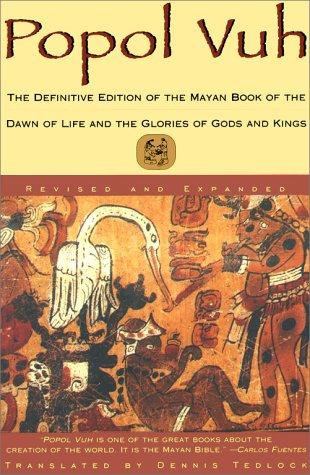
Dennis Tedlock’s Translation of the Popul Vuh
The Popol Vuh gives an account of the creation of the world and of all living beings, including the many trials by the gods to create human beings. It also includes the myth of the Hero Twins, which is great to use in class. The great ballplaying brothers 1 Hunahpu and 7 Hunahpu were summoned by the lords of Xibalba, to a ballgame in the Underworld. However, the gods won the game by deception and sacrificed the two brothers, hanging 1 Hunahpu’s head on a calabash tree, to proclaim their victory.
Later, the daughter of an Underworld lord walking past the calabash tree, spoke to the head, which spat in her hand, miraculously impregnating her. She fled to earth and bore twins, whom she named Hunahpu and Xbalanque. These twins became great ballplayers like their father and uncle, and were also summoned to a ballgame by the Underworld lords.
In their first game, the lords tried to use a skull as a ball, to which the Hero Twins refused. However, they had to undertake several trials in various Underworld houses, in which one, the “House of Bats”, Hunahpu was decapitated. The lords hung his head over the ballcourt and announced that it would be used as the ball at the next match. Yet Xbalanque fashioned a temporary head for his brother’s body and persuaded a rabbit to impersonate the ball, so he could retrieve Hunahpu’s head and restore him whole.
The twins then let themselves be sacrificed but were able to reappear in the underworld, entertaining as magicians in dismembering animals and humans then reviving them. Such a feat was enacted on the underworld lords, though obviously they were not revived. Subsequently the Hero Twins rose into the sky as heavenly bodies, namely the sun and the moon (Schele & Miller, 1986, 243-245).
The Books of Chilam Balam
The Books of Chilam Balam (Jaguar Prophecy) were written in the Yucatec Mayan language using the Latin alphabet during the 17th and 18th centuries. Both language and content indicate that parts of these books date back to the time of the Spanish conquest of Yucatán (1527–1546). The manuscripts are attributed to a legendary author called Chilam Balam. There are nine known books and each of them was kept in a different town in the Yucatán Peninsula. The most important were those from Chumayel, Mani and Tizimin. These books were concerned with aspects of local history, Maya myths and calendrical matters.
The Maya Codices
The Maya codices are paper books from the Postclassic and Early Colonial periods written in hieroglyphs. Only four books have survived; Dresden Codex, Madrid Codex, Paris Codex and the Maya Codex of Mexico (also known as the Grolier). As mentioned most of the codices were destroyed by conquistadors and Catholic priests in the 16th century. Some codices have been recovered from archaeological excavations, but they had degraded into unopenable lumps of plaster and paint. These codices are generally almanacs containing astronomical calculations.

An example of the Dresden Codex
Ethnographic studies
Ethnography is the scientific description of peoples and cultures today in regards to their customs and habits. As the Maya today follow some of the same traditions from the past, ethnographies can be used, albeit with caution, to gain an understanding of the past, for example pottery making (Reina and Hill 1978).
Archaeological Explorations and Excavations
The American diplomat and writer John Lloyd Stephens and the British artist Frederick Catherwood explored the Maya area between 1839-42 and wrote about their adventures in the Incidents of Travel in Central America, Chiapas, and Yucatán (1841), and the later, Incidents of Travel in Yucatán (1843). These books became worldwide bestsellers bringing the Maya and their ancient cities to popular attention.

Alfred Maudslay (British) and Teobert Maler (German/Austrian) were amongst the first Europeans in 1880’s and 1890’s to record the Maya ruins, visiting Maya sites and making detailed notes and drawings. Using photography and casts they were able to return to their native countries with much more precise images of Maya art and architecture. Maudslay’s work can be seen in the British Museum today.
Other famous explorers and later archaeologists include Sylvanus Morley (American) and amongst the British, Sir J. Eric S. Thompson and Ian Graham. The first scientific excavations in the Maya area was carried out in 1930’s-1950’s and were sponsored by Peabody Museum in Copan, Honduras and the Carnegie Institute of Washington in the sites of Uaxactún in Guatemala, Chichén Itzá in Mexico, Copán in Honduras and Baking Pot in Belize. Breakthroughs in hieroglyphic decipherment were seen in the 1950’s onwards thanks to Heinrich Berlin, Yuri Knorozov, Tatiana Proskouriakoff, Linda Schele and David Stuart.
Today we have field archaeologists unearthing sites and artefacts with the support of epigraphers (who decipher and interpret the Maya hieroglyphs), and art historians (who interpret the iconography on the painted vessels, sculptures and wall paintings). Together, these disciplines work well in helping to fill in gaps in the archaeological record.
A great example is Maya music, as musical instruments were made out of perishable materials such as wood, and so little survives, only those made of clay. In addition, any music, lyrics, melodies written down have since perished. However, many painted Maya vessels display scenes of musicians and the instruments they used, so with the help of iconography we can gain insight into the array of instruments used and where performances took place.

An example of musicians from a painted ceramic vase (Kerr 8947)
References Cited
De Landa, Diego. 1941. Relación de las Cosas de Yucatan. Transl. William Gates. Merida: Edición Yucateca.
De las Casas, Bartolomé, Edmundo O’Gorman (ed). 1967. Apologetica (e accent) historia sumaria. Universidad Nacional Autónoma de México, México.
Edmonson, Munro. 1971. The Book of Counsel: The Popul Vuh of the Quiche Maya of Guatemala. Middle American Research Institute Publication 35, Tulane University, New Orleans.
Reina, Ruben E. and Robert M. Hill II. 1978. The Traditional Pottery of Guatemala. University of Texas Press, Austin
Schele, L., & Miller, M. 1986. The Blood of Kings: Dynasty. And Ritual in Maya Art. Kimbell Art Museum, Fort Worth.
Stephens, John. L. 1841. Incidents of Travel in Central America, Chiapas and Yucatan. 2 vols. New York: Harper.
Stephens, John. L. 1843. Incidents of Travel in Yucatan. 2 vols. New York: Harper.
Tedlock, Dennis. 1996. The Popul Vuh. Touchstone, New York.
What is the date of the vase? For the purpose of art history.
It is dated to the Late Classic Period, AD 600-900.