
Monkeys
Three species of monkeys once lived in the Maya area – the spider monkey, howler monkey, and the capuchin, although only the spider and howler are found today.
Capuchin monkeys are particularly friendly and may have been most commonly adopted as pets in ancient times.
Dr Diane talks about Spider monkeys
Spider Monkey
Dark brown to black all over, they measure 30-63 cm from head to base of their tail. Their faces are bare skin. They weigh 6.6-9 kg and have potbellied bodies.

Swinging from long arm, to spindly leg, to prehensile tail (their fifth arm), they parade in groups, following paths of lianas and branches well known to them.
They leap and swing, propelling themselves by the elasticity of the bowed branches.
The monkey ahead helps the monkey behind reaching an arm or laying its body out like bridge – the two often embrace after the expanse has been crossed!

Troops ranging from 20-35 members sleep through the night in trees, but break into groups of five or so during the day’s hunt for food. Typically monkeys sleep sitting with legs pulled in and arms wrapped around themselves, huddled next to or embracing another.
Most of a spider’s monkey diet consists of fruit, nuts and young leaves.
Can you spot the baby spider monkey?
Howler and spider monkeys share in similar feeding habits and often the two eat in silence alongside each other – many jungle animals, such as collared peccaries depend on these discarded half-eaten fruit.
Some say they have watched the two species of monkeys embrace and even care for one another’s young!
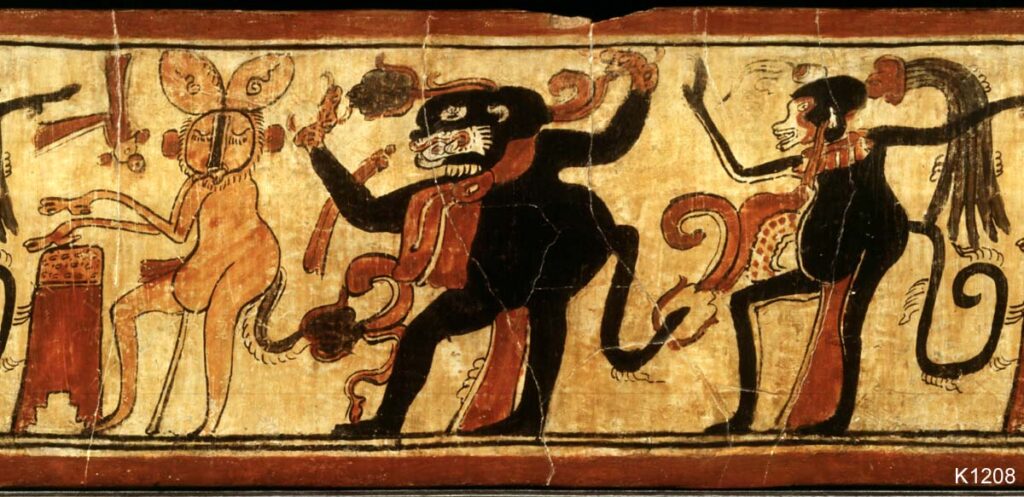
Spider monkeys are active and agile and have a well-deserved reputation as mischief makers. They have been known to hurl sticks and stones (and more unmentionable substances) at passersby.
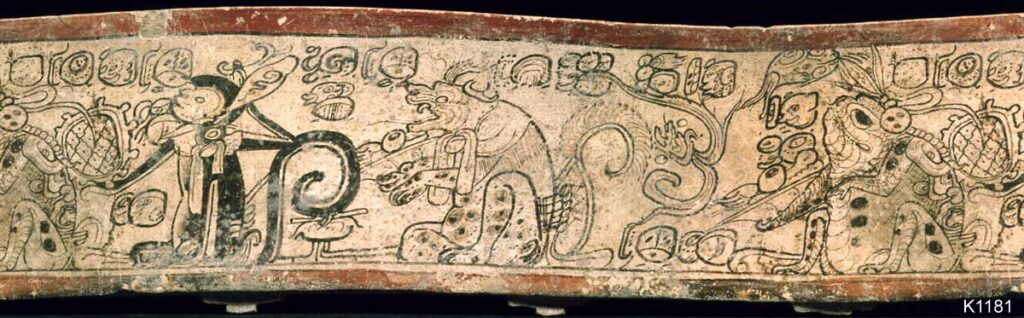
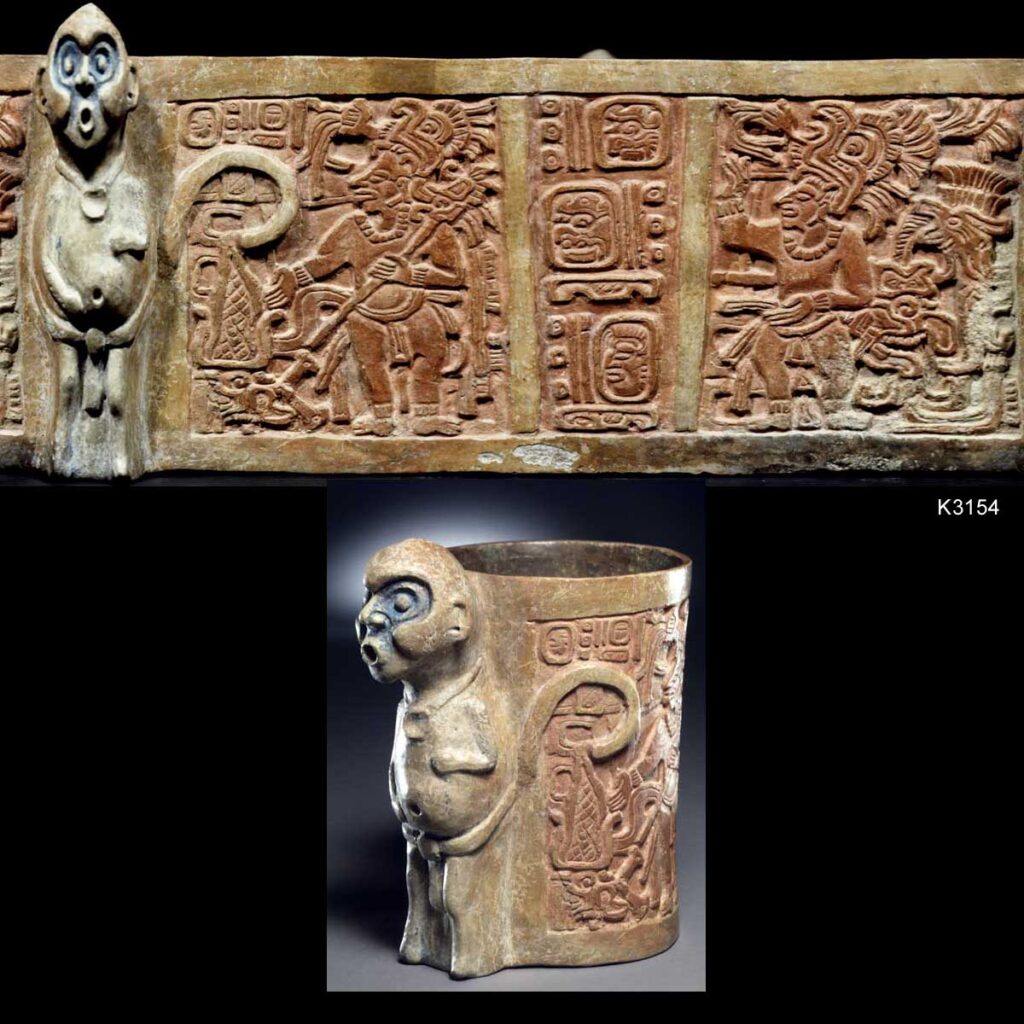
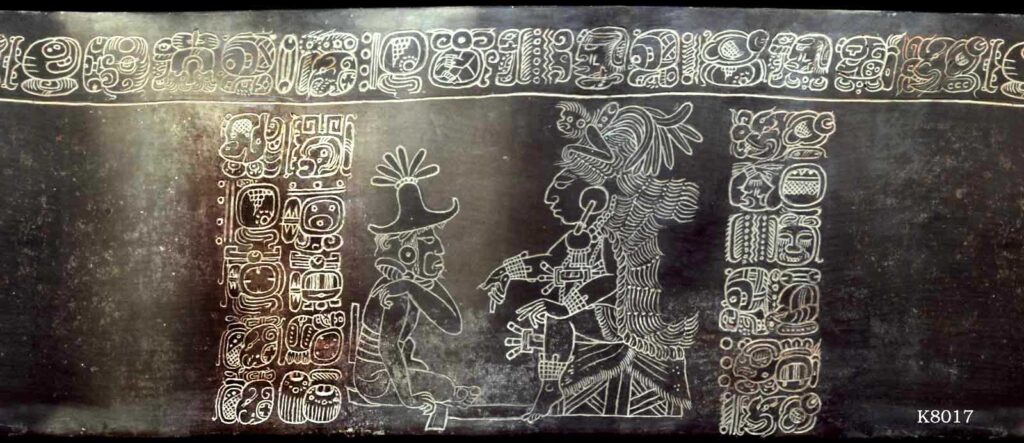
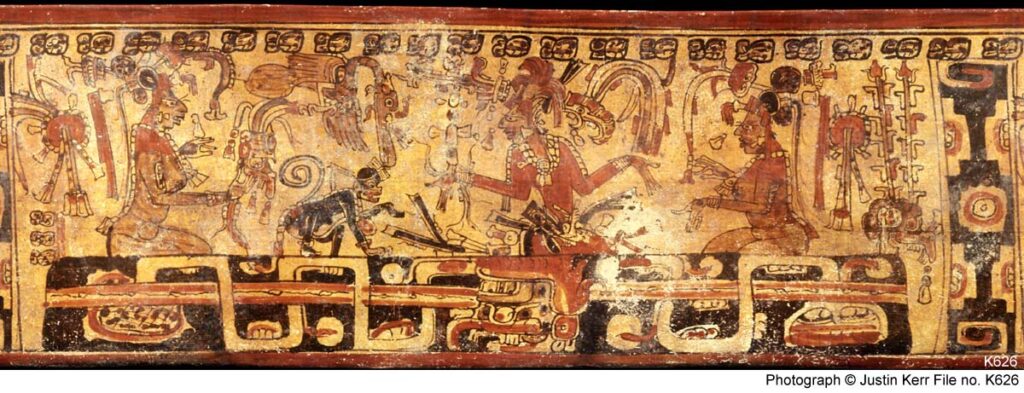
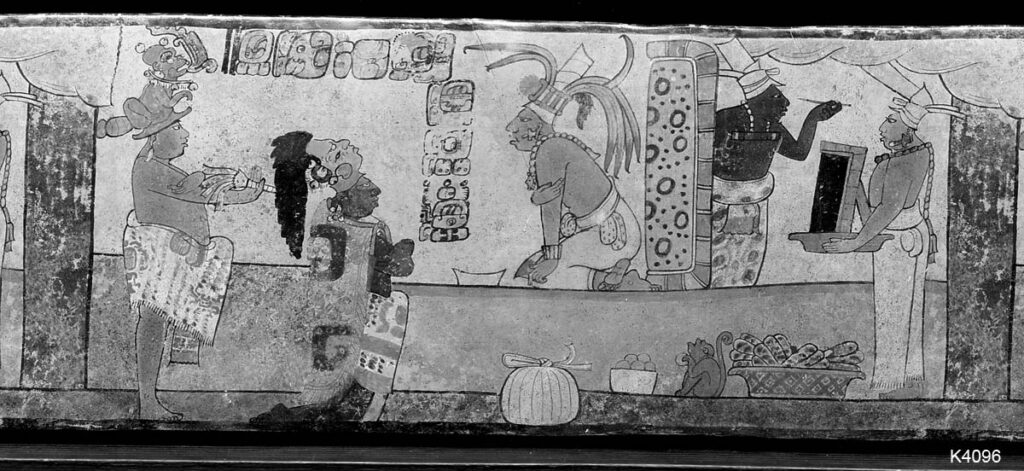
This playful mischievousness of the spider monkey was a favourite theme of Maya painters and monkeys are occasionally depicted scratching themselves, dancing, and enjoying fruits and cacao pods stolen from the kitchen gardens – have a look at some of these in the slideshow below.






Howler Monkey
The Mexican black howler monkey only occurs in Central America; in the Yucatan Peninsula, Guatemala and Belize. As a genus, howlers claim the title of being one of the largest monkeys found in the new world.

Covered entirely with long black hair, they are broad-set and thick-shouldered and measure between 52-64 cm from the head to the base of their tail, the tail acting as a fifth arm.
They have large heads and naked faces and below their beards throat sacs puff out when they howl.
Their roar is produced by the vibration of the hyoid bone in their larynx and is largely directed to warning other groups of their movements so that direct confrontation may be avoided.
As the sun rises the howlers inflate their throat sacs and emit a howl that can be heard for miles. It is quite deafening!l
Quite lethargic, sleeping some 15 hrs a day, and rarely ranging more than a quarter of a mile daily (400 m), they chew and climb slowly.
Following well trodden tree paths, they crawl from the tip of one branch to the tip of another, they do not leap and swing through the canopy like the spider monkeys.
Groups sound to locate one another and in order not to cross another group’s path. Ranges overlap, but the groups do not come into contact; they may pass within 200-250 m of each other peaceably after that, the calls become aggressive.
As they are slow creatures and do not make good pets as other monkeys do – they don’t entertain, just yell!
The Monkey in the Maya World
There is a wonderful story in the Popul Vuh that recounts the following:
Hun Batz (1 Howler monkey) and Hun Chuen (1 Spider monkey) were the twin half brothers of the Hero Twins, gifted in all the arts particularly, song, dance, writing and carving.
Hun Batz and Hun Chuen were jealous of their younger brothers and tried hard to overcome them, leaving them when young to perish on an anthill and in brambles and later demanding that the younger brothers do their hunting for them.


The Hero Twins had the last laugh though, as they convinced their twin half brothers to scale a tree to bring down birds stunned by a blowgun. When they reached the birds they found that the tree had grown, lifting them so high they could no longer descend.
The hero twins advised them to untie their loincloths to trail behind them and when they did this the loincloths changed in their hands to become a prehensile tail. Hun Batz and Hun Chuen had turned into monkeys!
There are actually two species of howler monkey in Guatemala; we found these extremely rare monkeys on branches over a creek that is a tributary of Rio Dulce, Izabal, Guatemala. There may be photos on one of our many web sites. It is called the mantled howler.